


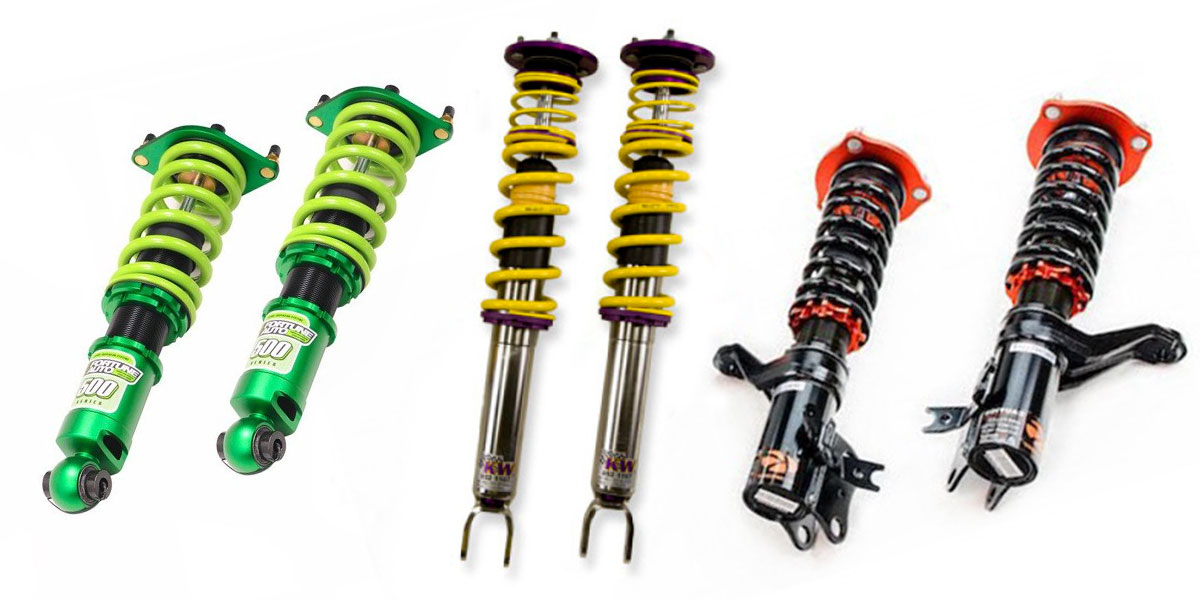
In the world of aftermarket performance parts, coilovers are one of the most popular mods for basically any car. The idea is that replacing your stock struts with coilovers will improve handling by reducing body movement. Of course, not all coilovers are made equal. Some are super cheap and offer little performance benefits, and some are super expensive and designed for race cars. Knowing what to look for can be quite confusing, so we’re going to cover everything you need to know about coilovers.
Shop for all coilovers here.
Basics
Coilovers are much like the OEM strut you can find on your vehicle. The main body is a shock absorber/damper. A coil spring sits on the body of the damper, right over the shaft, with a top plate before the top mounting bolts. Compared to the old-school spring and shock package, this is much smaller. What makes a coilover so much better than the OEM strut is adjustability, weight, strength, and overall performance.
The OEM strut is typically designed to be very compliant with the road, providing excellent ride quality at the price of relatively poor handling. Most consumers would rather have ride quality over superb handling, as most consumers are not looking to push their cars to the limits on a canyon road or race track.
Different types of springs
Not all springs are created equal. When it comes to aftermarket coilovers, there are two types of springs you will find: linear and progressive. Many high-end coilovers you will find use linear springs, and most enthusiasts will tell you that linear springs are the way to go, but that’s not true in every case. Linear springs are great for track use, and progressive springs are great for road use, to put it simply. Many coilovers come with progressive springs, as most cars are not dedicated track toys.
What makes linear springs so good for track usage is their simplicity. One of the keys to a good track setup is having very predictable handling. It’s much easier to push hard when you know exactly what the car is going to do at every corner. With the spring rate being constant, it’s also very easy to tune the damper. Unfortunately, a linear spring is going to be much stiffer than a progressive spring, as progressive springs start out soft and begin to stiffen up as the spring is compressed.
Twin Tube vs Monotube
Something else to consider when shopping for a set of coilovers is deciding between Twin-Tube and Monotube. On the outside, these two types of dampers can look completely identical, but underneath there are quite a few fundamental changes which alter dampening performance.
A twin-tube design can be found on the majority of OEM shocks, low-end coilovers, and even mid-level coilovers designed for street use. It’s not a bad design by any means. Twin-tube uses an inner and outer tube. The inner tube holds the piston shaft, valve, and oil. The outer tube holds damper oil and nitrogen gas. The design allows for more suspension stroke without increasing the height of the body, providing better ride quality.
High-performance vehicles and coilovers designed for race use often use a mono-tube design. This design holds everything in one tube and separates everything with a floating piston. Although this design is simpler than the twin-tube design, it allows for bigger and stronger parts, better heat dissipation, and quicker response.
Spring Adjustments
With the majority of aftermarket coilovers, the manufacturers determine the ideal spring rate either through testing or just estimating. The spring rate is not usually completely fixed, as there is some spring rate adjustment. This adjustment will typically come in the form of an adjustable collar which threads up or down the body and either compresses or decompressed the spring. This adjustment effects spring pre-load which increases the amount of force needed to compress the coilovers, but does not increase spring rate. Pre-load is typically used to adjust suspension sag. This is something that is pretty easy to adjust incorrectly and make handling worse.
Height Adjustments
Some coilovers are not height or spring adjustable whatsoever, but that’s a very uncommon thing to find. You’ll typically either find a partially threaded coilover, which allows height adjustment at the cost of suspension travel, or a fully threaded coilover, which allows spring pre-load and ride height to be adjusted independently. Being able to adjust ride height and spring pre-load independently allows for much greater suspension tuning, but it also increases the chances that the end-user will incorrectly adjust it. It’s best to leave this kind of stuff to the pros who know what they’re doing.
Damper Adjustments
The next thing you will find on many aftermarket coilovers is dampening adjustment. Some only offer a few clicks worth of adjustment and some offer up to 32-clicks of adjustment. It should be noted that many coilovers which claim to have 32-clicks of adjustment really have closer to 10-clicks of adjustment. High-quality coilovers such as Fortune Auto don’t have an insane amount of clicks, as it’s not necessary.
Some dampers allow for compression and rebound to be adjusted independently of each other. Some even offer low-speed and high-speed dampening adjustment. If you want to get the best dampening possible, it’s best to take it to the pros. Improper dampening adjustments will make your car handle very poorly.
Summary
Things like shock fluid, internal designs, piston coatings, and more, greatly affect the performance of coilovers. There are a lot of really good coilovers on the market and some are better than others. Our performance specialists can help you find the perfect coilovers at the right price. Call 1-480-966-3040 or email [email protected] to talk with one of our performance specialists.
Shop for all coilovers here.

