

When it comes to optimizing your suspension setup for better handlings or looks, few elements are more critical (or more misunderstood) than coilover spring rates. For a street car, a track weapon, or anything in between, you need the right spring rate to balance performance, comfort, and control.
In this guide, we’ll break down everything you need to know about coilover spring rates. We’ll cover everything from the basics of how they work to how to choose the best spring rate for your vehicle weight, intended use, and desired handling characteristics. Keep reading to learn more.
What Is Spring Rate?
Spring rate can be a very technical subject for those without in-depth industry knowledge or an engineering background. But, put simply, spring rate refers to how much load a spring can support per inch (or millimeter) of compression. Even simpler: how much weight it takes to compress the spring a given amount.
Spring rate is measured in pounds per inch (lb/in) or kilograms per millimeter (kg/mm). A higher spring rate means a stiffer spring that compresses less under load, while a lower rate means a softer spring that allows more compression for the same weight.
For example, a coil spring with a spring rate of 400 lb/in will compress one inch for every 400 pounds of load applied.
Why Spring Rates Matter
The spring rate you choose can affect your ride height, handling, and overall performance. Spring rate can determine how your vehicle responds to cornering forces, braking, and acceleration.
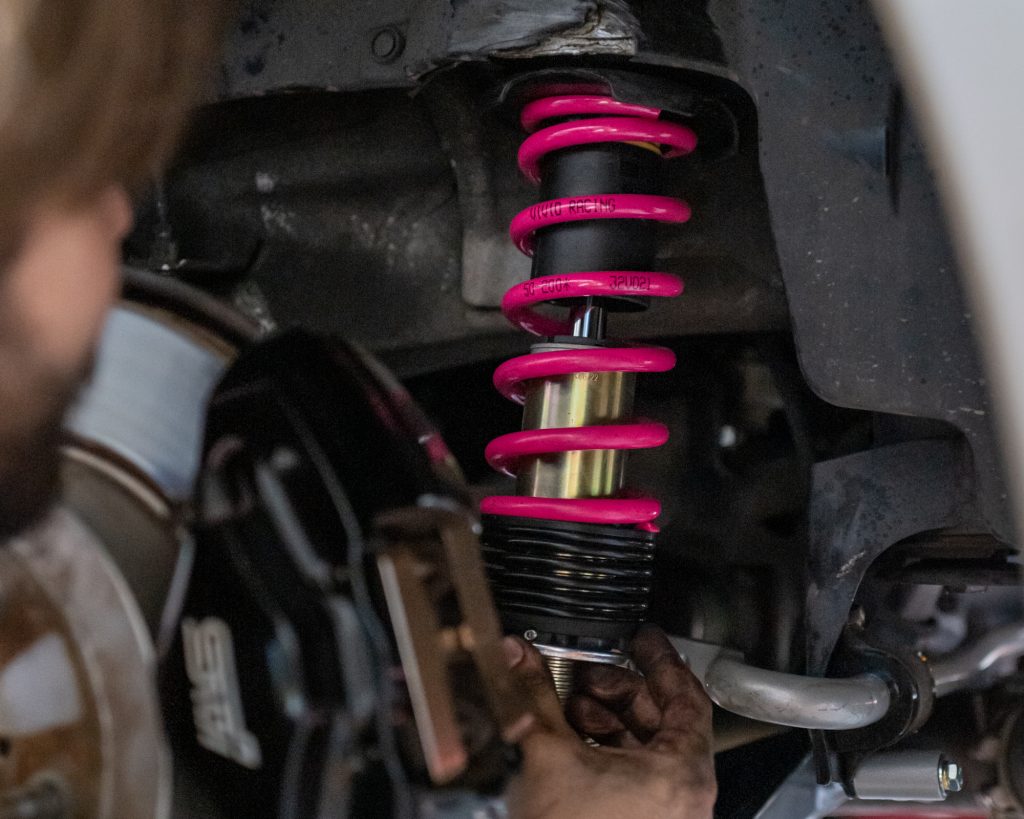
But it’s important to remember that we’re discussing spring rate in teams of coilovers, which means that there are more variables to things like ride height and handling. Perch height plays a direct role in ride height, as some coilovers have top and bottom adjustable collars. And, over compressing the collars will create pre-load, which means it’s more of a factor of collar compression than spring rate.
But, that said, choosing the wrong coilover spring rates can cause poor ride quality, poor stability, and unpredictable behavior under load. Here are a two common goals drivers may have when selecting spring rates:
- Street driving: prioritize a smoother ride, better comfort, and predictable behavior.
- Track driving: aim for better control, reduced body roll, and improved handling at high speeds.
Key Factors in Determining Spring Rates
There’s no universal “best” spring rate. The ideal setup depends on several variables:
1. Vehicle Weight and Corner Weight
The overall vehicle weight and corner weight (the weight on each wheel) are the starting points when determining spring rates because it’s important to understand load distribution. Heavier vehicles need stiffer springs to control suspension movement, while lighter vehicles require a lighter rate spring without sacrificing performance.
Use corner balancing or scales to weigh each wheel for an accurate baseline.
2. Sprung Weight vs Unsprung Weight
Only the sprung weight (everything supported by the coilover springs, including the body, chassis, occupants) should be considered when calculating coilover spring rates. Components like wheels, tires, and control arms count as unsprung weight and are not supported directly (or held off the ground) by the coilovers.
3. Suspension Design and Shock Angle
A suspension setup with inboard coilovers, such as on double-wishbone systems, means the shock angle affects how the spring rate translates to wheel movement. The more angled the shock, the more spring rate you’ll need to maintain effective support during corners and road bumps.
4. Ride Height and Spring Length
The desired ride height can influence your choice of spring length and stroke. A lower ride height often requires shorter springs with the appropriate stroke, which can affect how the coilover spring behaves under compression.
Street vs Track: Choosing the Right Coilover Spring Rates
So how do you choose the right spring rates for your build? Start with your end goal:
For Street-Driven Cars
If your car is a daily driver taking the occasional spirited drive, your setup should balance comfort with performance. A softer spring rate (e.g., 6k front / 4k rear) typically works well, especially with compliant damping, but this is obviously vehicle-dependent.
Benefits:
- More compliant over bumps and uneven surfaces
- Better for long drives or commuting
-
Easier on existing chassis components
For Track-Only or Aggressive Performance Builds
Race cars or dedicated weekend track builds can benefit from higher spring rates (e.g., 10k front / 8k rear) to minimize body roll and maximize cornering response. Again, these numbers are vehicle-specific.
Benefits:
- Improved chassis control under high load
- Sharper handling characteristics
- Better response under trail braking and hard acceleration
Be aware that stiffer springs may reduce ride quality and could cause issues on rough roads.
How to Measure and Calculate
If you’re planning to customize your own coilover spring setup, here’s how to approach it:
Step 1: Measure Corner Weight
You’ll want to start by establishing a baseline. Weigh each corner of the car (with driver and full fluids) to determine load distribution. If your car is relatively stock, you may be able to find these specs online.
Step 2: Consider Shock Angle
Account for angle if the coilover isn’t vertical—this affects spring rate efficiency. Use trigonometry or online calculators to factor this in.
Step 3: Choose Spring Length, Inner Diameter, and Free Length
Choose coilovers with coil springs that meet your needs in terms of diameter, length, and stroke. Many brands provide a part number chart for coilovers that helps you find the right parts.
Step 4: Account for Preload
A little preload is often needed to keep springs seated at full droop, but more preload than necessary can increase effective spring rate and impact handling.
Example Spring Rate Setups
| Vehicle Type | Use Case | Front / Rear Spring Rate (kg/mm) |
| Subaru WRX | Daily / Street | 7k / 5k |
| BMW M3 (E92) | Mixed Use | 9k / 8k |
| Honda S2000 | Track / Autocross | 12k / 10k |
These are just guidelines. Factors like suspension design, weight distribution, and ride height goals all play a role.
Upgrading Coilover Springs: Final Thoughts
Upgrading your coilover spring rates can be a great way to fine-tune your car’s handling and performance. It can inspire confidence on the track or provide a smoother ride on the street, if done correctly. Always consult manufacturer guides, use the correct part numbers, and match your coilovers, springs, and shocks appropriately.
When in doubt, reach out to our team at Vivid Racing. We can help you determine the best coilover spring setup for your specific goals and vehicle.
Glossary of Coilover and Suspension Terms
Spring Rate: The amount of force required to compress a spring by one inch (lb/in) or one millimeter (kg/mm). A higher spring rate = stiffer spring.
Coilover: A suspension component that combines a coil spring and a shock absorber into a single, adjustable unit.
Coilover Spring: The replaceable spring used on a coilover system. It determines the ride height and contributes to handling performance.
Sprung Weight: The portion of a vehicle’s weight supported by the suspension (body, interior, drivetrain). This excludes wheels, tires, and brakes.
Corner Weight: The amount of weight distributed to each wheel. Used to fine-tune suspension balance and select proper spring rates.
Preload: The amount a spring is compressed when the suspension is fully extended. Preload affects ride height and spring tension.
Ride Height: The distance between the bottom of the car and the ground. Adjustable with coilovers and spring perch height.
Stroke: The total amount of travel available in a suspension shock before it bottoms out or tops out.
Shock Angle: The angle at which the shock or coilover is mounted. Affects effective spring rate and how forces are transferred.
Free Length: The total uncompressed length of a spring with no load applied. Used when selecting new coil springs.
Inner Diameter: The measurement of the inside width of a coil spring. Must match the coilover’s design.
Stiffer Spring: A spring with a higher rate that resists compression more. Used for better handling but reduces ride comfort.
Lighter Rate Spring: A spring with a lower spring rate. Offers a softer, more compliant ride.
Load: The force or weight applied to a spring or suspension component.
Suspension Setup: The complete arrangement of a vehicle’s shocks, springs, arms, and linkages. Optimized for specific performance goals.
Handling Characteristics: The way a car responds to inputs such as steering, braking, and throttle—affected heavily by suspension tuning.