


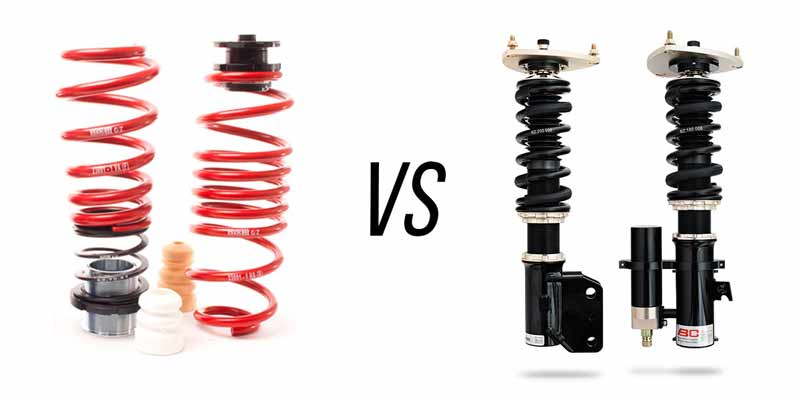
There is no denying that lowered cars look much better sitting closer to the ground. That’s why dropping some springs or coilovers on a ride is one of the top mods serious enthusiasts do to transform their build. Apart from merely increasing visual appeal, lowering your vehicle can lower the center of gravity to increase stability throughout turns or during emergency maneuvers.
You have a few options for lowering your car, but the two most popular are coilover and lowering springs. There is a clear difference between the two, and each system has its pros and cons. So how do you know which system is right for you? We know it can be tough deciding between lowering springs vs coilovers, so we put together a short article to help you out.
Lowering Springs vs Coilovers: The Differences
Here’s a quick-and-dirty breakdown on lowering springs vs coilovers. Lowering springs fit in the stock location, replacing your stock springs, lowering the vehicle and reducing wheel gap. They can be used with the existing shocks and struts, though many choose to upgrade them as well. Coilovers are a combination set of springs and shock absorbers or struts with adjustable heights and dampening capabilities. You can consider both a performance upgrade, but here’s a bit more information.
Lowering Springs
Lowering springs drop your vehicle by using shorter springs with slightly stiffer rates, lowering the center of gravity and improving stance. They’re a budget-friendly option for better looks and some street performance—perfect if you’re not chasing lap times.
However, because they typically increase spring rates without matching damper upgrades, your stock shocks may struggle, leading to bounce, poor control, and premature wear. This is especially true with cheap or poorly engineered springs, which can push your dampers beyond their ideal operating range.
Most lowering springs don’t offer adjustability in ride height or damping, limiting fine-tuning. That said, a few kits like H&R’s VTF line provide height adjustability while retaining stock dampers—useful for vehicles with magnetic or adaptive suspension.
Lowering springs make sense if you want a simple, affordable drop. But for aggressive driving or full control over handling, coilovers or matched damper kits are a better route.
Lowering Springs Pros and Cons
Lowering springs improve stability and reduce body roll, all while being affordable and easy to install. They work with your existing suspension components, but they come with fixed ride height and spring rates—so there’s no adjustability once they’re installed.
Click To Shop All Lowering Springs Right Here.
Coilovers
Coilovers solve the damping mismatch by pairing stiffer springs with properly tuned dampers—but not all coilovers are created equal. Cheap, off-brand kits often hurt handling due to poor testing, weak damping, and limited suspension travel. Stick to reputable brands to avoid these issues.
Quality coilovers offer adjustable ride height, spring preload, and damping (sometimes even high/low-speed or rebound/compression tuning). This level of control is ideal for enthusiasts and track use, allowing you to fine-tune handling and reduce unwanted body movement for better grip and confidence.
Just be careful—incorrect adjustments can make handling worse, so professional setup is recommended.
Coilovers Pros and Cons
Coilovers offer a lot of performance right out of the box—and you’ll feel the difference fast. You can tweak ride height, damping, and even swap springs to dial in your setup. Most systems also let you replace individual parts like dampers, springs, or top mounts down the line. Just keep in mind: all that performance can come with a stiffer ride, and going cheap on coilovers can hurt both comfort and safety.
Click To Shop All Coilovers Right Here.

Coilovers vs Lowering Springs: Uses
These two systems work completely differently, and it’s important to understand them to make the best choice.
- Street Use: No interest in hitting the track? A set of lowering springs should do the job, especially if you are on a budget. Not only that, but coilovers can bring your car so low to the ground that hazards like speed bumps and uneven roads can cause you to bottom out and damage your car. It can also make simple tasks like pulling into a driveway or gas station more difficult.
- Track Use: If you live for the thrill of tearing down a racetrack, make sure your car is ready. If you’re willing to spend a little more, a set of coilovers offers more adjustability—perfect for the track. When you’re driving at high speeds, you’ll need exceptional handling and control when cornering, which is what coilovers do best.
- Ride Quality: Coilovers typically offer drivers a better ride quality, as they allow you to lower your vehicle and still get the feel and handling you’re used to. While lowering springs don’t necessarily lead to poor ride quality, if your goal is for your car to drive as smoothly as possible, coilovers are the right choice for you.
- Price: Lowering springs are all about value, allowing you to lower your car without having to break the bank. Coilovers are more expensive. If you are operating on a tight budget, though, lowering springs will get the job done in a simpler, quicker, and more cost-effective way.
What to Look For in Aftermarket Coilovers
Coilovers are similar to your car’s stock struts and shock absorbers; a damper with a coil spring wrapped around it. The big difference? Adjustability. Here’s what you need to know.
Linear and Progressive Springs
There are two main types of spring: progressive and linear. At the end of the day, they’re all metal rods that have been twisted into a coil, but the tightness and pattern of the coil change how the spring reacts to suspension movement.
- Progressive Springs: The majority of OEM struts or lowering springs are “progressive” springs. Progressive springs often don’t have a fixed stiffness. As the spring becomes more compressed, the spring rate increases. The progressive nature of the spring rate means bumps that don’t cause a ton of compression can be absorbed slightly better.
- Linear Springs: In a high-performance lowering spring or coilover, you are more likely to find a “linear” spring. Linear springs don’t change based on suspension movement. This means handling is much more predictable, and damper tuning is much simpler, but at the cost of poor ride quality.
For street use, a progressive spring is great because it provides much better ride quality, but for those who want the best out-right performance, a linear spring is a better option.
Different Types of Dampers
When shopping for coilovers, you’ll come across twin-tube and monotube designs. They might look the same from the outside, but they perform very differently.
- Twin-tube setups—common in OEM and budget coilovers—use two chambers: one for the piston and one for oil and gas. They allow more suspension travel in a compact package, which helps with ride comfort, especially on the street.
- Monotube designs, typically found in high-performance coilovers, house everything in a single chamber: This setup allows for stronger internal components, better cooling, and faster response—ideal for aggressive driving or track use.
Height Adjustments
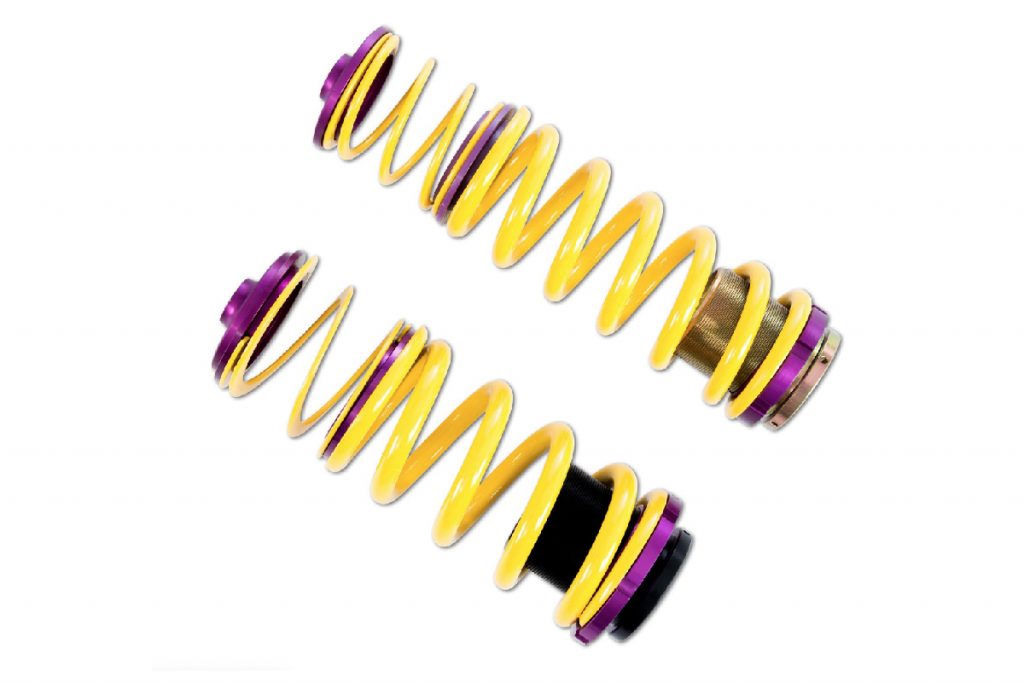
Coilovers are almost always adjustable. You’ll typically find a partially threaded coilover, which allows height adjustment at the cost of suspension travel, or a fully threaded coilover, which allows spring pre-load (the force required to compress a spring from an already compressed state) and ride height to be adjusted independently. Being able to adjust ride height and spring pre-load independently allows for much greater suspension tuning.
Damper Adjustments
Most coilovers offer dampening adjustment. Some dampers allow for compression and rebound to be adjusted independently of each other. Some even offer low-speed and high-speed dampening adjustment.
A Summary of the Difference Between Lowering Springs and Coilovers
Lowering springs are a simple, affordable way to improve your car’s stance—and maybe even handling—but they come with trade-offs. Coilovers offer far more control and adjustability, especially if performance is your priority.
Suspension upgrades can feel overwhelming, but it really comes down to your goals, budget, and how you drive. Coilovers are a powerful upgrade, but for daily driving or casual track days, lowering springs still hold their own.
If you’re looking at purchasing some lowering springs, coilovers, or an air suspension system for your car, please do not hesitate to contact us. We can be reached by phone at 1.480.966.3040 or via email at [email protected].
Some of our popular suspension brands:
- KW – KW Suspension is an international group of companies that specializes in innovation in suspension technology.
- KSport – KSport is the leader in aftermarket suspension, providing coilover systems and air suspension for driving enthusiasts for over 16 years.
- Tein– Tein crafts products “for your driving pleasure”, creating accessible and high-performing products to help make your time behind the wheel a pleasurable experience.
- H&R – H&R specializes in producing top-of-the-line suspension for its customers, ensuring a smooth and safe ride.
- Eibach – If you are looking for a high-quality coilover suspension, Eibach is a great place to start. They have developed a reputation as one of the coilover industry leaders.
- Moton – Moton Suspension Technology is the suspension champion, helping racers and street drivers alike improve their cars.
AST – AST Suspension was established in 2000 to offer amazing products, constant innovation, and impeccable customer support to customers looking for a new suspension.


What would be best for a 1991 Camaro RS.
It really just depends on how you intend to use the car. If you are strictly street driving the vehicle and want a lower stance you can go with lowering springs. If you plan on taking the vehicle to the track it would be recommended to spend the extra cash and run coilovers for the height and damping adjustability. If you are building a show car or want to have on the fly height adjustment, it is recommended to use air suspension. Hope this helps out in your decision!